
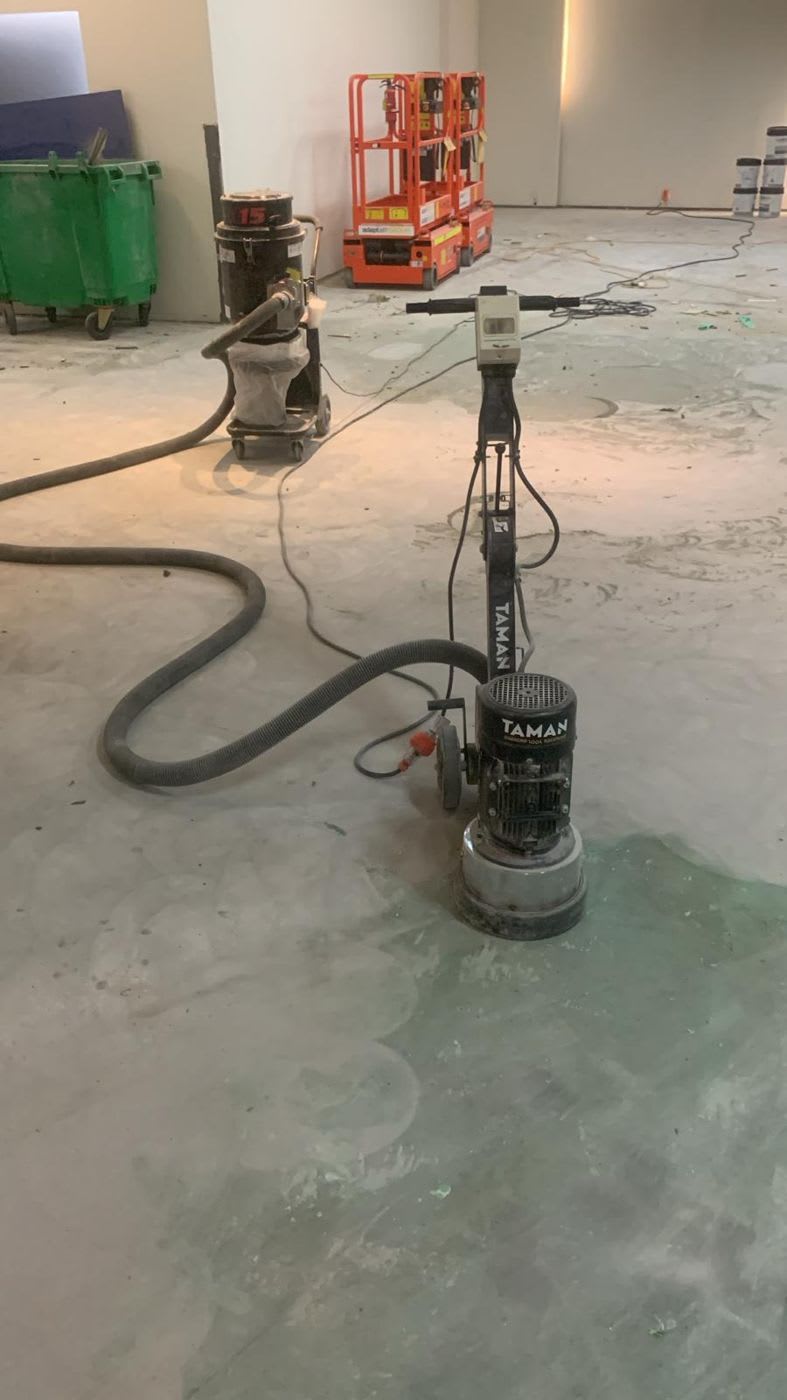
Once the tiles are up, the adhesive or bedding left on the slab still has to come off before a new floor can go down. For a thin layer of tile adhesive over a small area, a floor scraper can do the job. For anything larger, diamond grinding with dust extraction is the fastest way back to sound, flat concrete, and a thick sand-and-cement bed has to be broken up or machine-stripped first. Chemical removers do little to cement-based adhesive. Whatever the method, the slab has to finish flat and clean, and the silica dust has to be controlled.
This guide covers the cement-based adhesive and bedding left behind by ceramic, porcelain and stone tiles on a concrete slab.
Thin-set adhesive or a sand-and-cement bed?
Start by working out what you are dealing with, because it decides the method.
- Thin-set tile adhesive is a cement-based adhesive spread a few millimetres thick with a notched trowel. It is common under newer floor tiles and most wall tiles, and it leaves ridges across the slab when the tiles come up.
- A sand-and-cement bed, also called a mortar bed or screed, is a much thicker layer. Many floor tiles sit on one, and most older bathrooms do. It usually has to be broken up or machine-stripped rather than scraped by hand.
Lift a tile at the edge of the room and look at the underside and the slab. If you can see trowel lines and a thin grey or white layer, it is thin-set. If the tile comes up with a thick, sandy layer of mortar attached, it is a bed.
Your three options: scraping, chemicals or grinding
Scraping
A long-handled floor scraper, or a hammer and bolster, will take off adhesive that has already let go of the slab, and a powered chipping hammer speeds up small areas. Scraping suits a small room with a thin layer, but it rarely gets the slab completely clean. It tends to leave a skin of adhesive and the low ridges between the trowel lines, and those still have to be dealt with before the new floor goes down. On large areas, professional crews use ride-on and walk-behind scrapers to strip tile and bedding far faster than hand tools.
Chemical adhesive removers
Chemical removers are made for organic adhesives such as mastics and glues. Cement-based thin-set and mortar beds are not glue, so solvents do little to them, and acid-based products bring their own handling and disposal problems. Any chemical also leaves a residue on the slab that has to be cleaned off before a new adhesive or coating will bond. For tile adhesive on concrete, chemicals are rarely the right tool.
Diamond grinding
A floor grinder fitted with diamond tooling takes thin-set, leftover bedding, ridges and high spots back to sound concrete and leaves the slab flat in the same operation. It is the standard next step after tile removal on a concrete slab. Grinding without dust control is the dangerous part, though: the grinder has to be connected to an extractor with HEPA filtration, and the room should be sealed off from the rest of the building.
| Method | Best for | Watch out for |
|---|---|---|
| Scraping | Small areas and thin adhesive that has already let go | Leaves a skin and ridges; slow by hand |
| Chemical removers | Organic glues and mastics | Little effect on cement-based adhesive; residue to clean off |
| Diamond grinding | Thin-set, bedding residue, ridges and high spots | Needs dust extraction with HEPA filtration |
Why the slab has to be flat
New flooring is only as good as the surface under it. Ridges of old adhesive and patches of bedding stop new tiles from bedding evenly, show through vinyl, and stop timber boards from lying flat. They also stop a new adhesive, membrane or coating from bonding properly to the concrete.
Grinding gives the slab two things at once: a flat surface and a clean, open profile for the next product to grip. Coatings and some adhesives need a particular surface profile, described as a CSP (concrete surface profile) rating, usually CSP-1 to CSP-3 depending on the new flooring. Check what your flooring supplier or installer needs before the slab is prepared, so it is ground once and ground to the right finish.
Keep the silica dust down
Tile adhesive, tile bedding, grout and concrete all contain crystalline silica. Scraping, chipping or grinding them releases fine dust that can be breathed deep into the lungs, and long-term exposure causes silicosis, an irreversible lung disease. Australian workplace health and safety regulations limit silica exposure to 0.05 mg per cubic metre over 8 hours.
That is why low-dust methods matter on this job more than most:
- Connect a dust extractor with HEPA filtration directly to the grinder and to any chipping tools.
- Seal the work area with plastic sheeting and tape, and cover doorways and vents.
- Keep other people, children and pets out of the area until the clean-up is finished.
- Clean up with a HEPA vacuum, never by dry sweeping, which just puts the fine dust back into the air.
- Wear a fitted P2 or P3 respirator, not a paper dust mask.
For more on the health side, read our guide to silicosis and silica dust.
How long it takes
With the right equipment, a typical residential floor is ground and prepped in a day, and a single bathroom or small floor is often stripped of tile and adhesive in a day as well. A thick mortar bed, a large open-plan area or a commercial floor takes longer, mostly because of the volume of heavy waste that has to be broken up and carried out. By hand, the same job takes several times as long, and the slab is rarely as flat at the end of it.
Can you do it yourself?
A small area of thin-set that is already coming away can be a weekend job with a scraper, a respirator and a lot of patience. If the building dates from before 1990, have the tiles, the adhesive and any sheeting behind them tested before you scrape or grind; our internal strip out page explains the Queensland rules for older buildings. Hiring a floor grinder is a different matter. The machine is heavy, the dust is the real hazard, and a hire grinder is only as safe as the extractor connected to it. A slab that is gouged or left uneven by an inexperienced operator then needs patching or levelling before the new floor can go down.
If you do take it on, work in small sections and keep the extractor running the whole time. If the adhesive will not come away without heavy force, it is probably a bed rather than thin-set, and it needs breaking up first.
When to call in a professional
Bring in a contractor when:
- the area is larger than a small room
- the building was built before 1990
- the tiles were laid on a thick sand-and-cement bed
- the home or business stays occupied while the work is done
- the new floor needs a flat, clean slab with a particular surface profile
- you want the tiles, bedding and adhesive removed and the slab ground as one job
Strip It Out removes the tiles, the bedding and the adhesive, then grinds the slab flat, with HEPA dust extraction connected to our equipment and the work area sealed off. See our tile removal and concrete grinding services for how we work, or our step-by-step guide to how professional tile removal works.
Get a free quote
Send us photos of the floor, the room sizes and what is going down next, and we will give you a free, fixed-scope quote. Call 0430 030 633 or contact us online. We work across the Gold Coast and Brisbane.